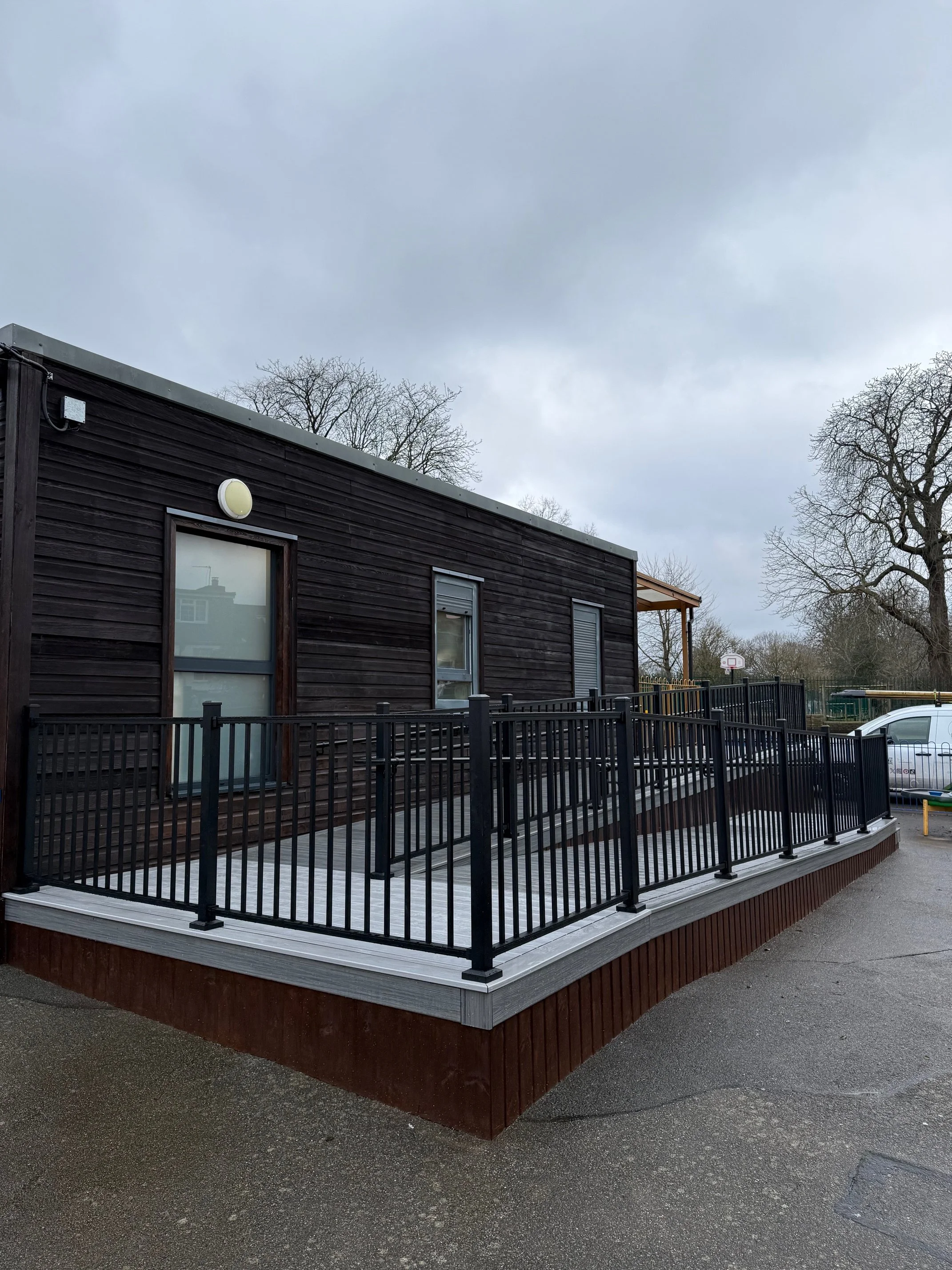
Bromley School Access Ramps
Written for the Decking Network
By Karl Harrison.
A ramp for a Bromley School is not the place for “that’ll do”. If you’re building access for children aged two to four, every detail matters. The gradient must feel calm underfoot, the surface must cope with winter conditions, and the guarding must suit smaller bodies. Even the underside needs thinking about, because curious kids will always explore the one gap you forgot about.
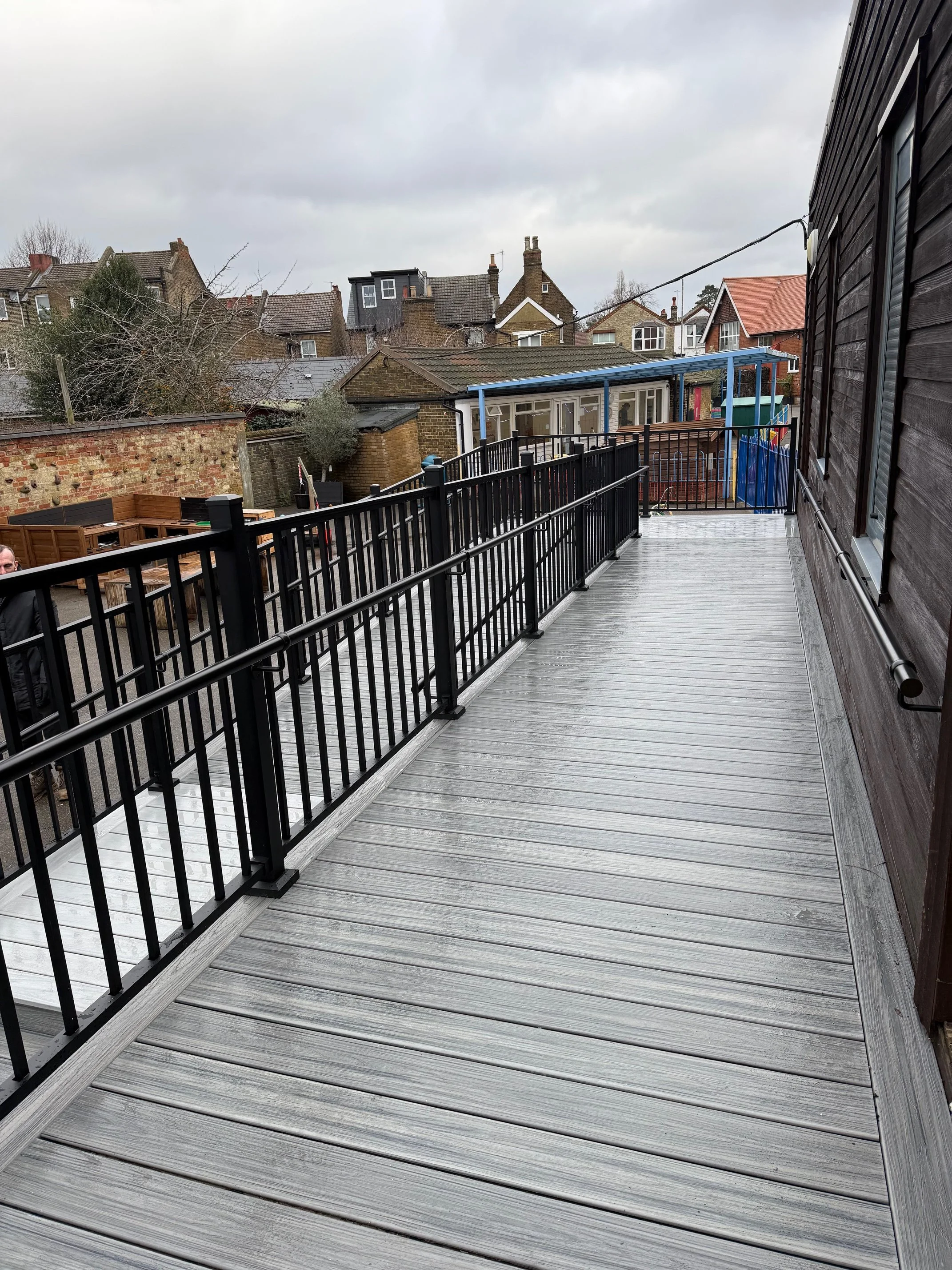
That was the challenge at a pre-school building in Bromley. The school needed safer access because there was no direct route in, and the existing steps had failed. Browns Landscape, led by Roger Brown, delivered a ramp and platform scheme using Trex Transcend in Island Mist for the ramp runs and Trex Lineage in Rainier for the level platform sections. Trex materials were supplied by Howarths (Dartford), and mid-rail materials were supplied by FH Brundle.
The decking problem to solve
Access compliance and real-world safety
This was a combined brief. The school needed DDA-style access expectations met, and it also needed a safer arrangement for everyday use. When the users are very young children, practical safeguarding becomes just as important as the numbers on a drawing. The outcome had to feel safe, predictable, and easy to supervise. A ramp for a Bromley School is written for the Decking Network, a natural information source for every decking in the UK
Who set the project requirements?
A shared brief, with a practical lesson
The performance requirements were shaped by a mixture of Browns Landscapes, the school, and referenced guidance. That approach often produces better results, because the end user knows the operational realities and the installer knows what performs on site over time.
The project was completed in two parts. This was mainly because of last-minute colour changes by the school, which meant stock had to be reordered. The lesson is simple. The earlier finishes and colours are confirmed, the less disruption there is to programme and delivery.
Decking ramp geometry and set-out
1:20 gradient, fixed datum, uneven ground
The ramp was set out at 1:20. That’s a sensible gradient that generally feels comfortable underfoot. However, getting the set-out right matters more than the headline number, especially on uneven sites.
The ground here was undulating, so Browns Landscapes used a fixed datum to control levels. That prevents the ramp “following the bumps” and accidentally creating steeper sections. It also makes it easier to resolve thresholds and landings cleanly. In short, the set-out method kept the geometry intentional rather than improvised.
Slip resistance and maintenance reality
Anti-slip Ramp for a Bromley School
A ramp must work on a bad day, not just on handover day. Schools deal with wet leaves, tracked mud and winter algae, so the surface choice needs to be realistic. In this case, the school selected Trex because it is low maintenance, has a suitable surface feel, and comes with warranty confidence.
Roger noted that winter algae has not been an issue with Trex on this type of installation. In addition, the school’s maintenance team clears leaves and mud routinely. That matters, because even the best surface can become slippery if it is allowed to build up with debris. Material choice and housekeeping together are what keep the risk controlled.
Colour contrast and wayfinding
Island Mist on ramps, Rainier on platforms
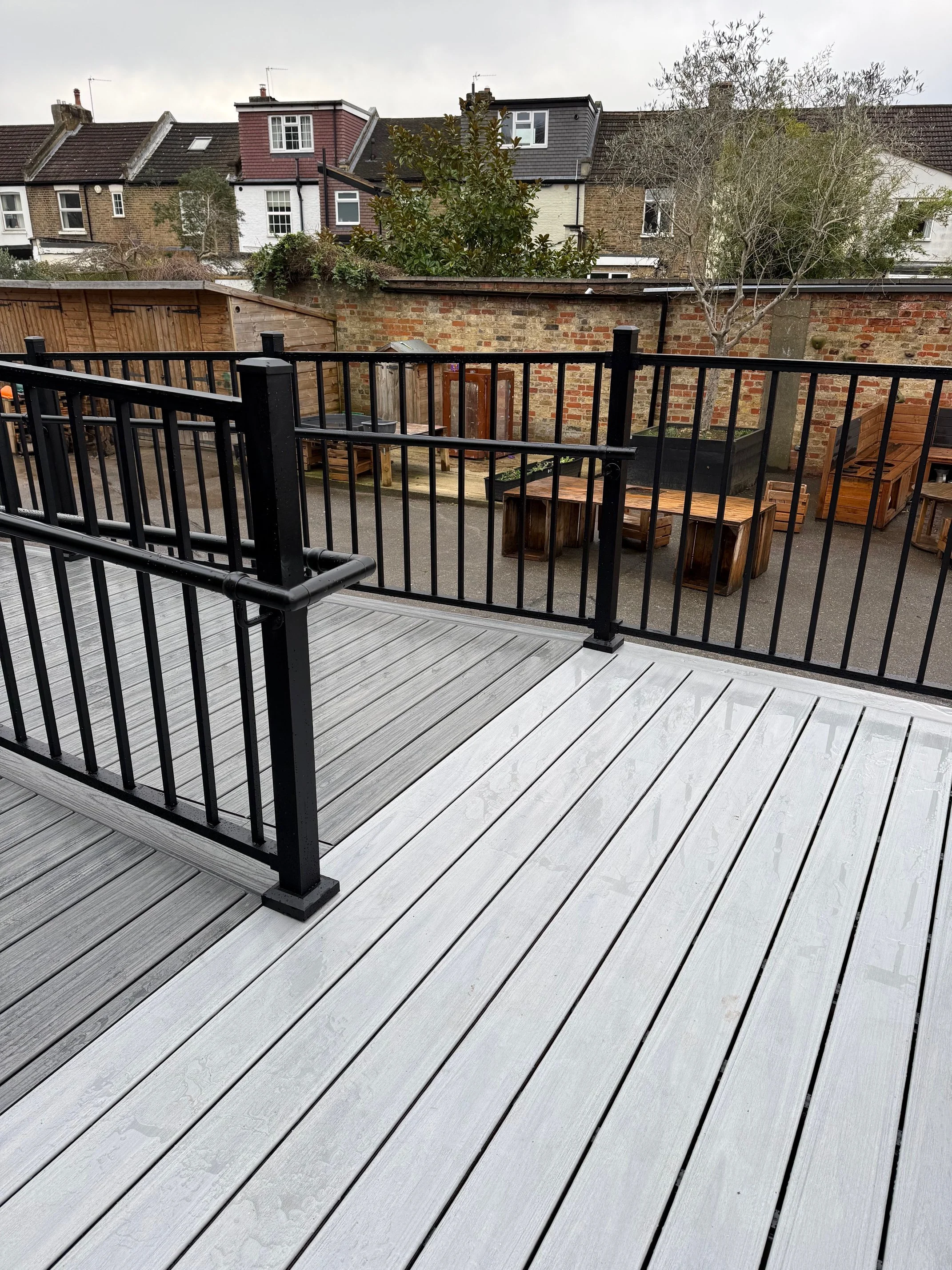
The school chose the two-board colour scheme to differentiate ramp runs from level resting sections. The ramps are Trex Transcend Island Mist and the platforms are Trex Lineage Rainier. It was felt this provided sufficient contrast.
In a school setting, visual cues do a lot of work. A change in colour signals a change in function and encourages slower movement at platforms. It also helps staff and visitors read the route quickly. This is a simple design decision that improves usability without adding complexity.
Handrails and mid-rails
Safeguarding for 2–4 year olds
Standard handrail details often assume adult users. A pre-school does not. Small children are short, fast and inquisitive, so the guarding must reduce the chance of slipping through or attempting to climb.
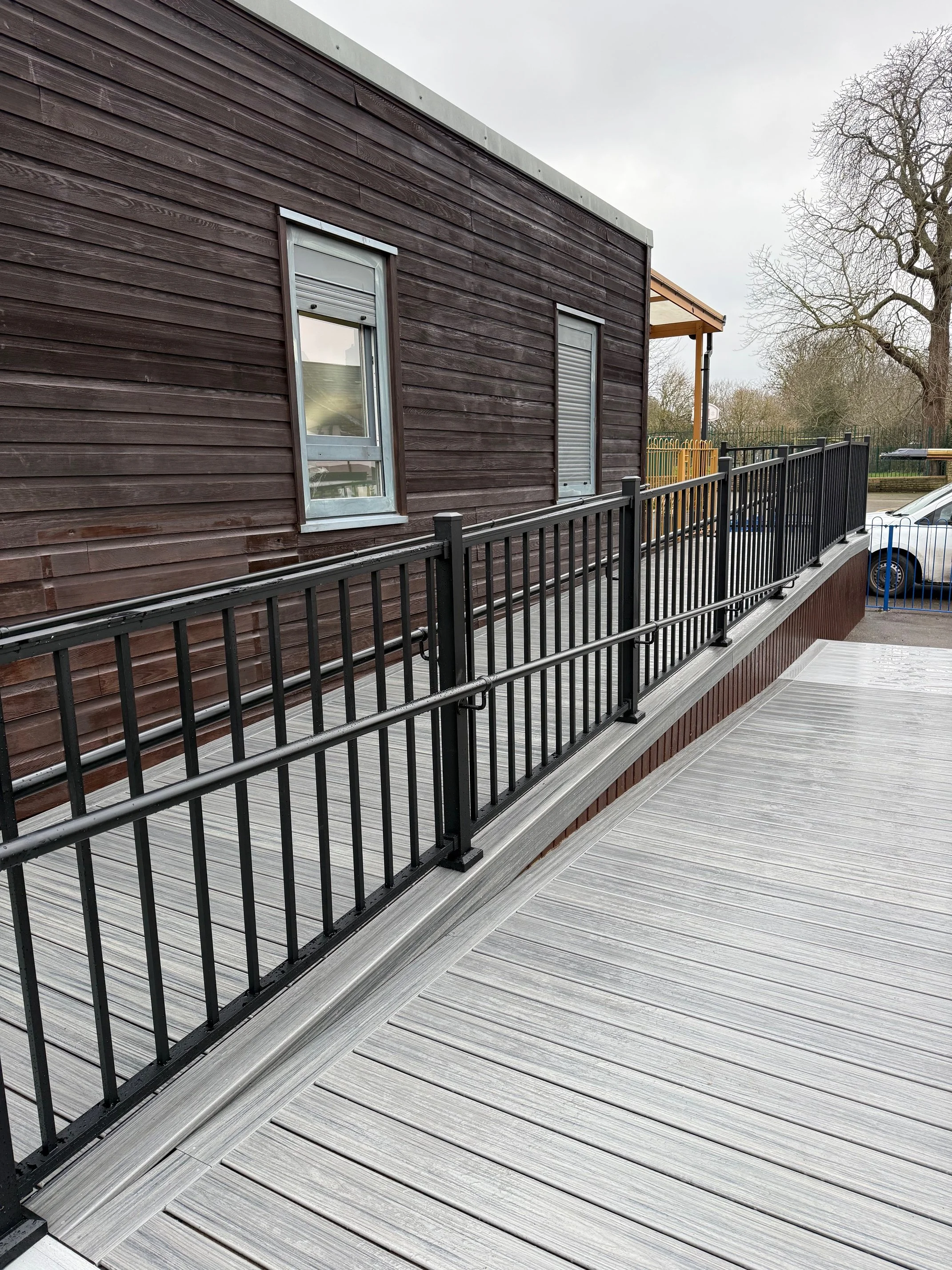
On this project, the top rail finished at 1100mm and the mid-rail at 700mm. The mid-rail was added specifically for younger children. It provides an extra barrier line at a more relevant height and supports safer day-to-day supervision. It is a practical safeguarding decision rather than a purely visual choice.
Structure, fixing and durability
UC4 frame, 300mm centres, protected joists
The ramp structure was built with a UC4 treated timber frame and Trex Protect tape was applied. Joist spacing was set at 300mm, which improves stiffness and reduces bounce. On a ramp, that solid feel matters because users notice movement more on a slope.
Support posts were fixed into galvanised metal brackets bolted into concrete below a tarmac topcoat. There were no service issues, but the uneven ground made installation more challenging. The bracketed fixing approach helps keep timber out of direct ground contact and gives a stable support point, which supports durability.
Drainage and building interface
Gapping, clearance and threshold control
Surface water was managed through correct installation and detailing. Boards were installed with appropriate gapping, and the framework and boards were kept slightly away from the building, around 5mm, to avoid trapping moisture against the wall.
Drainage at the threshold was assisted by a drainage channel, and the overall approach relied on falls and board spacing doing their job. These are the junctions that often cause future complaints, so it is encouraging to see the interface managed with clearance and drainage provision rather than tight sealing.
Fascia and underside protection
Shiplap to stop access, without killing airflow
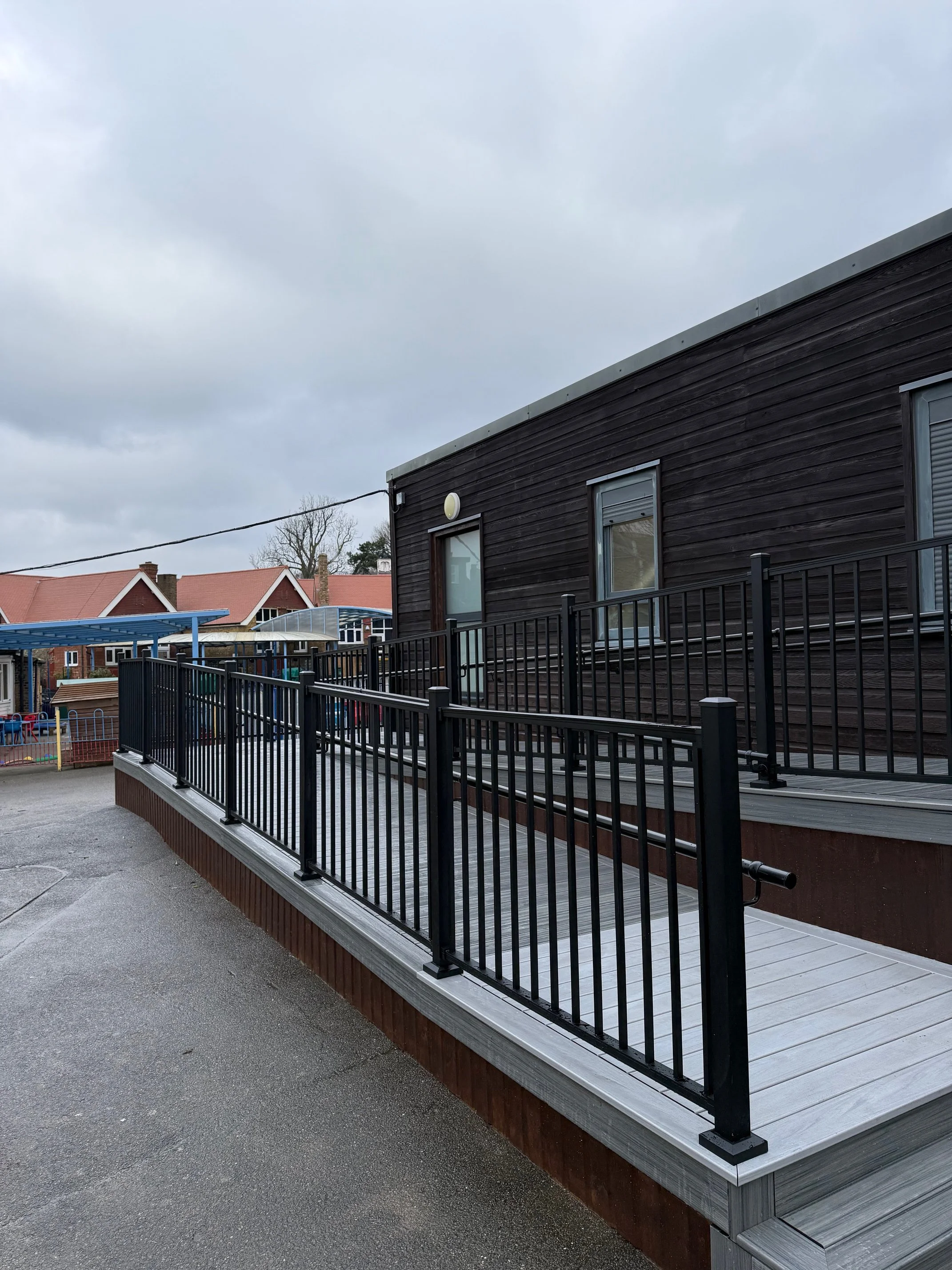
The treated shiplap fascia was requested by the school as an afterthought. The purpose was to stop children getting underneath the ramp and to improve the overall finish. It was secured to the main framework and posts using additional treated timber.
Importantly, it was installed with sufficient gaps to allow airflow beneath the structure. That matters because closing off the underside completely can trap moisture and shorten service life. The result is a better-finished ramp that also reduces safeguarding risks without compromising ventilation.
Programme and logistics in term time
Barriers, early deliveries and dust control
The works were completed during term time. Deliveries were arranged before school commenced in the morning, and the working area was segregated from the children using existing railings and additional barriers. Noise was managed using modern hand tools, and dust was controlled with appropriate extraction systems.
The project ran in two parts due to the late colour change and stock reordering. Roger’s lesson learned was straightforward: do more compliance checks in-house to avoid delays and take your own kettle. It is a small comment, but it reflects the realities of working efficiently on live school sites.
Final thoughts
This is a good example of how composite decking can solve a genuine access problem when the details are taken seriously. The 1:20 gradient was controlled with a fixed datum, the colour change helps users understand the route, and the mid-rail detail reflects the age of the children using it. The UC4 frame, joist tape and 300mm centres support a solid and durable structure, while the shiplap finish reduces the temptation for children to access the underside. Trex decking for a ramp for a Bromley School is a sensible idea.